
ITER vacuum vessel assembly in France progresses steadily, with five European sectors at different critical stages
 Scan to share
The vacuum vessel assembly work for the International Thermonuclear Experimental Reactor (ITER) project in southern France is progressing steadily. As the core component of the ITER tokamak device, the vacuum vessel will contain the plasma confined by superconducting magnets, serving as the critical space where fusion reactions occur. This stainless steel ring-shaped structure weighs approximately 5,200 tonnes in total, measures 19.4 meters in diameter, and consists of nine sectors, five of which are manufactured by Europe.
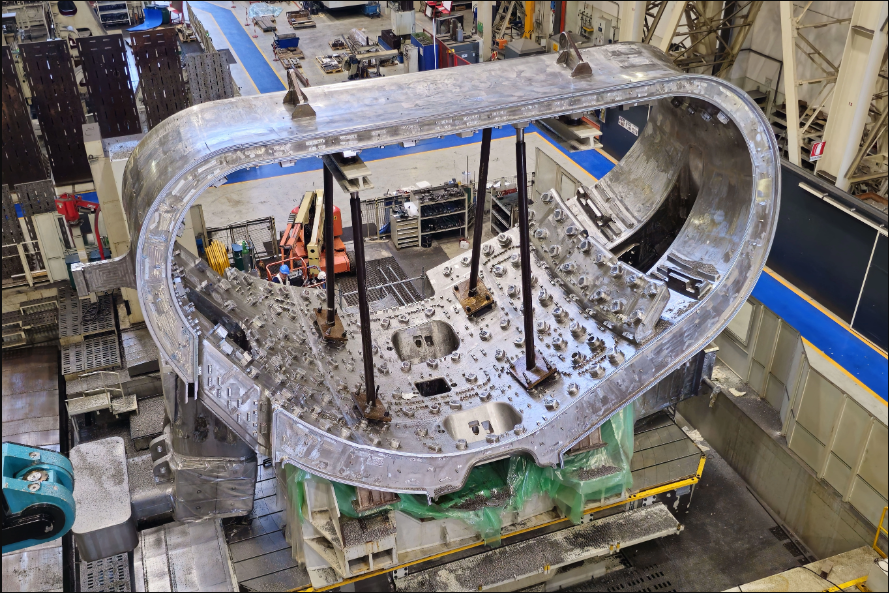
The European Fusion for Energy organization (F4E), together with the AMW consortium comprising Ansaldo Nucleare, Westinghouse Electric Italy, and Walter Tosto Company, is responsible for the related manufacturing work. Currently, the five vacuum vessel sectors under Europe's responsibility are at different stages, including manufacturing completion, on-site machining, sub-assembly, and in-pit installation.
At the Westinghouse Electric plant in Monfalcone, Italy, Sector 2 has entered its final manufacturing stage. The supply chain for forming and welding this component involves more than 15 companies. Recently, the technical team has been using a dedicated milling machine to perform final machining on the component's side surfaces to meet stringent geometric dimensional requirements. As planned, once the sector is ready, it will be placed in a protective cover and shipped by sea to the ITER site in southern France in September.
After Sector 3 arrived at the ITER site in May this year, metrology personnel conducted comprehensive inspections of its inner and outer surfaces. The component was then rotated to the required orientation and transferred to the former cryostat workshop. Technicians used customized robots to machine the sector edges, removing excess metal and repairing local depressions to ensure consistent contour at the interface between adjacent sectors, creating conditions for subsequent welding.
In the assembly hall, Sector 9 is undergoing sector module assembly. Two 22-meter-high sector sub-assembly tools are set up on site to install the thermal shield and two toroidal field coils onto both sides of the vacuum vessel sector. The completed sector module weighs approximately 1,200 tonnes. Currently, Sector 9 has been mounted on one of the assembly tools and is being prepared for integration with the second D-shaped magnet. The module is expected to be moved into the tokamak pit by the end of this year, with heavy lifting operations potentially lasting more than 24 hours.
The Sector 4 module has been in the tokamak pit since May. A large number of sensors for monitoring the ITER magnetic field, along with their cables, will be installed on this sector. Scaffolding has been erected on site to facilitate access to various positions on the inner wall. Welders will progressively install more than 2,000 small brackets to secure the sensors and cables. The positioning work will be carried out using 3D software and laser tools to ensure installation accuracy.
Sector 5, the first vacuum vessel sector delivered by Europe, also completed its final positional adjustment recently. Although the movement distance was only a few centimeters, this step formally seated it onto the gravity support structure and released the load previously borne by the temporary support beams. Once all equipment is fully assembled, these support structures and the concrete roof beneath them will bear a weight of approximately 23,000 tonnes.
According to the ITER assembly plan, all nine vacuum vessel sectors will ultimately be secured to the support structure and welded together to form a complete ring-shaped vessel. Viewed from above the tokamak pit, the overall outline of the vacuum vessel is gradually taking shape, but assembly, welding, and internal component installation in the core area will continue to progress.
Disclaimer: Information republished from partner media, institutions or other websites is provided for reference and communication purposes only. It does not imply endorsement of its views or verification of its accuracy. Please contact us if any content infringes rights or requires correction.