
U.S. Advanced Light Source Upgrade to Enhance Nanoscale Research Capabilities for Quantum Materials
 Scan to share
The Advanced Light Source (ALS) at Lawrence Berkeley National Laboratory in the United States is enhancing its quantum materials research capabilities through an upgrade project. As a U.S. Department of Energy Office of Science user facility, ALS has supported researchers worldwide over the past 30+ years in studying quantum materials such as superconductors, topological insulators, and correlated electron materials, leveraging its synchrotron soft X-ray, ultraviolet, and full-spectrum X-ray experimental capabilities.
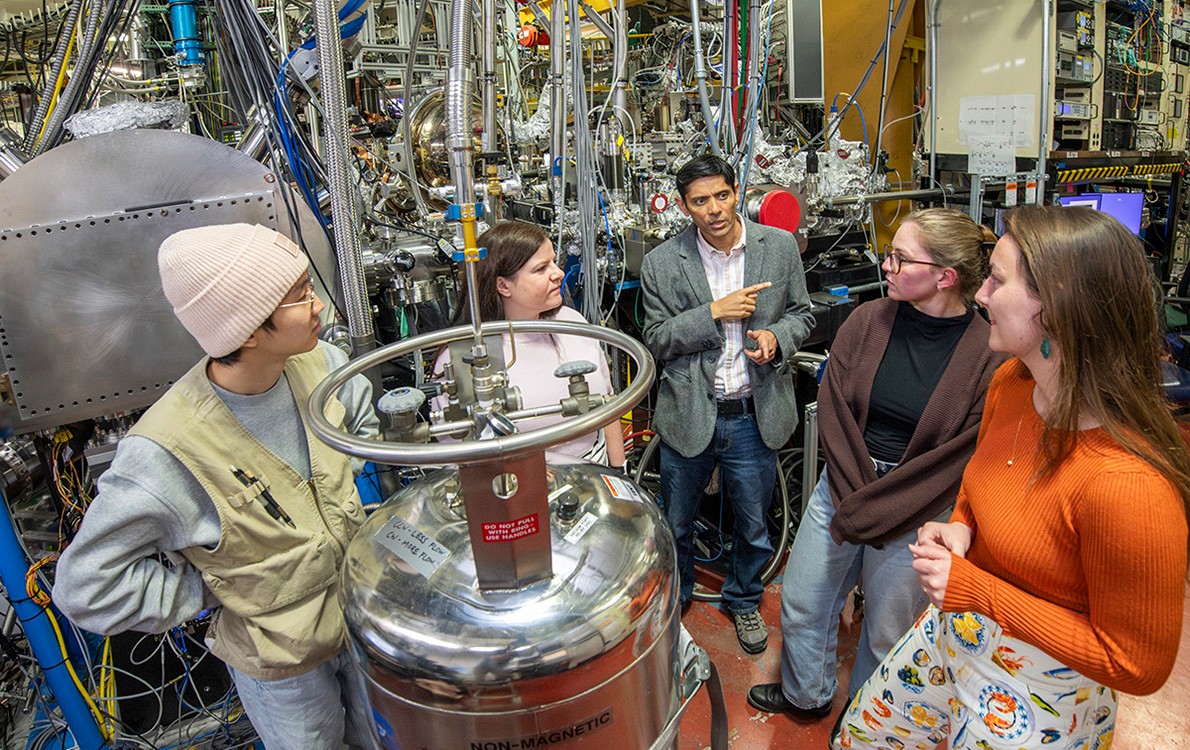
Doctoral students Wei "Francis" He (left), Kate Matthews (second from right), and Robin Greifke (right) from the University of California, San Diego, are from the Alex Frañó research group at the ALS COSMIC beamline (7.0.1). They are collaborating with ALS scientists Sujoy Roy (center) and Sophie Morley (second from left) to study the properties of a quantum material of significance to neuromorphic systems. (Image credit: Robinson Kuntz/Berkeley Lab)
Quantum materials exhibit strong electronic interactions that can give rise to collective behaviors such as superconductivity and exotic magnetism that are difficult to explain with conventional theories, and are considered closely linked to the development of next-generation electronic devices, information technology, and quantum computing. ALS's existing instruments, such as angle-resolved photoemission spectroscopy (ARPES), have been used to analyze the energy, momentum, and spin information of electrons in materials, helping researchers study the formation mechanisms of high-temperature superconductors, superconducting topological insulators, and novel quantum materials.
In related research, a team from the Massachusetts Institute of Technology used the ALS MAESTRO ARPES instrument to measure electron velocities associated with superconductivity in kagome metals. Researchers at Rice University have also utilized ALS's spin-resolved ARPES capability to study the energy, momentum, and spin characteristics of electrons in crystalline compounds of indium, tantalum, and sulfur, exploring their potential applications in spintronics and quantum computing materials.
According to the upgrade plan, ALS-U will produce X-ray beams with higher brightness and greater coherence, enabling researchers to observe defects and electronic phase behavior in quantum materials at smaller scales. After the upgrade, X-ray beams are expected to be focused to scales smaller than 25 nanometers; a further envisioned "ultimate nano angle-resolved photoemission spectroscopy" technique would advance research targets to the level of individual defects, for analyzing key microstructures in materials such as superconducting qubits and strange metals.
In addition to ARPES, ALS also plays a role in coherent soft X-ray scattering research. The currently used COSMIC instrument will in the future be succeeded by the planned new instrument FLEXON, which will assume related functions. FLEXON will include capabilities such as X-ray photon correlation spectroscopy (XPCS) and coherent X-ray reflectometry microscopy, which can be used to study fluctuations and distributions of charge and spin in quantum materials at nanometer scales and nanosecond time ranges.
Related researchers have stated that brighter, more coherent beams will help observe how qubit defects affect coherence and will also advance research on neuromorphic computing materials. Neuromorphic computing seeks to emulate the information processing approach of biological neural networks, leveraging the electronic properties of materials to achieve more efficient, low-energy computing. After the ALS upgrade, researchers will be able to track the interaction processes of correlated electrons at the nanometer scale, providing finer experimental support for research on quantum computing, next-generation electronics, and artificial intelligence-related hardware.
Disclaimer: Information republished from partner media, institutions or other websites is provided for reference and communication purposes only. It does not imply endorsement of its views or verification of its accuracy. Please contact us if any content infringes rights or requires correction.