
South Korean research team evaluates pipe rupture risk in nuclear power plants using probabilistic analysis
 Scan to share
Researchers from Seoul National University of Science and Technology in South Korea have recently proposed a sensitivity analysis method based on probabilistic fracture mechanics to evaluate the rupture frequency of main coolant piping systems in nuclear power plants. This method can analyze the impact of uncertainties and modeling assumptions on prediction results, helping engineers distinguish extremely low-probability events from relatively more likely failure scenarios.
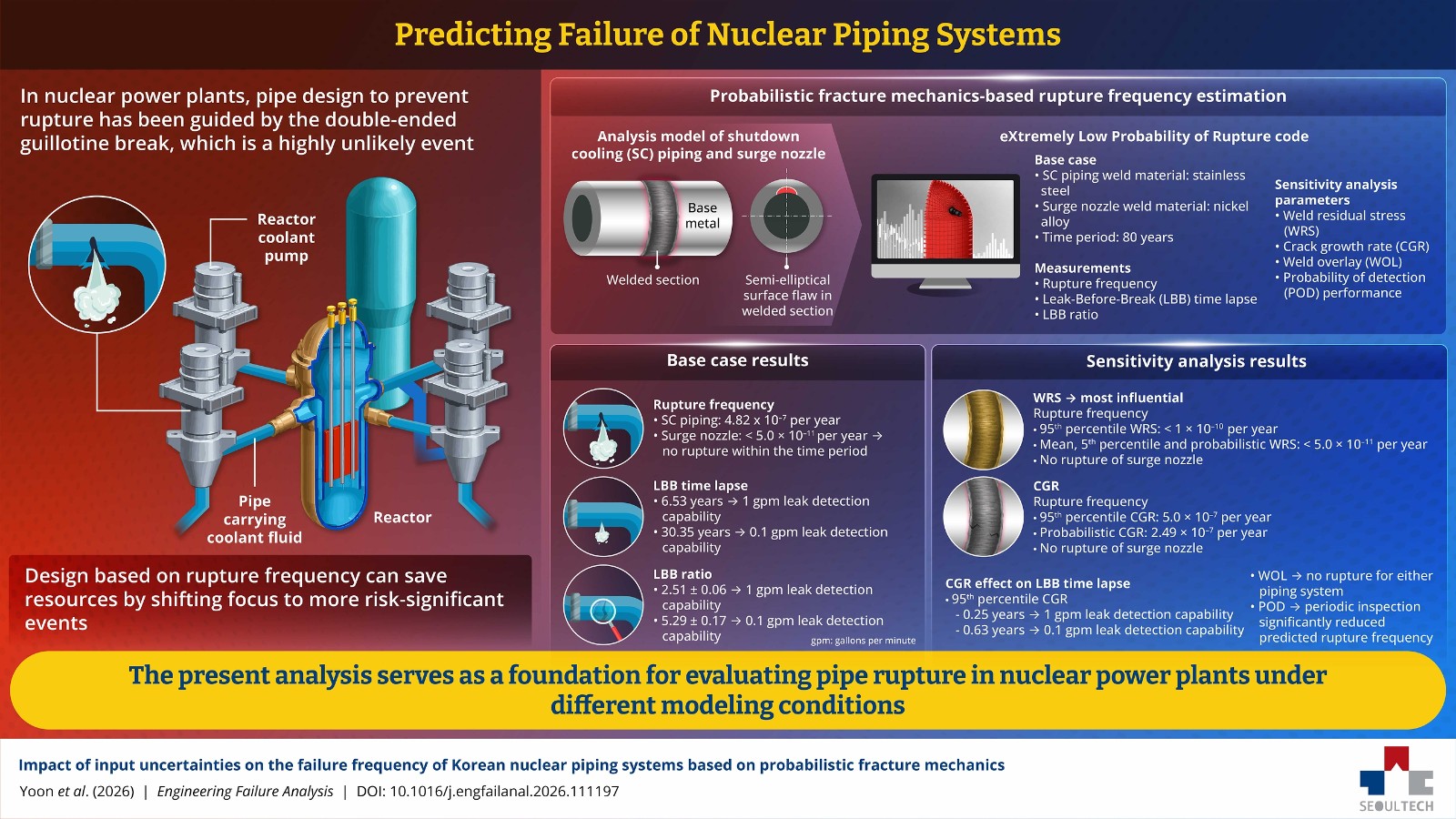
In nuclear power plants, the main coolant piping system plays a critical role in maintaining structural integrity under normal reactor operating conditions. A pipe rupture could trigger a loss-of-coolant accident, and therefore this system has long been included in the key scope of nuclear power plant safety design and assessment. In traditional designs, a double-ended guillotine break of the largest main pipe is typically considered a key design basis accident, but the probability of such a large-break accident is extremely low. By evaluating the frequency of different rupture scenarios, engineers can more accurately determine actual risks and optimize the allocation of safety resources.
Previously, the industry primarily relied on the deterministic "leak-before-break" (LBB) method and statistical approaches based on operating experience to evaluate pipe rupture frequency. However, these methods have difficulty fully reflecting degradation mechanisms and quantifying the impact of individual parameters on results.
To address these shortcomings, the research team led by Professor Nam-Su Huh from the Department of Mechanical System Engineering at Seoul National University of Science and Technology adopted a probabilistic fracture mechanics approach to investigate the fracture behavior of piping systems in South Korean nuclear power plants. Huh stated that probabilistic fracture mechanics can estimate pipe rupture frequency by accounting for factors such as the randomness of material behavior, degradation over time, loading conditions, and inspection effectiveness. The research findings were published online on July 1, 2026, and will appear in Volume 197, Part B of Engineering Failure Analysis, scheduled for release on November 1, 2026.
The research team used the extremely low probability of rupture (xLPR) program for the assessment and selected two LBB-certified piping systems from a nuclear power plant in South Korea as the study objects: the SC piping and the surge nozzle. The researchers first established a baseline scenario with fixed parameters to serve as a reference for sensitivity analysis, and simulated an 80-year operating period for the nuclear power plant, with stress corrosion cracking (SCC) set as the sole degradation mechanism.
On this basis, the team further analyzed the impact of factors such as welding residual stress (WRS), crack growth rate (CGR), weld overlay (WOL) repair, and inspection performance on predicted rupture frequency. The results showed significant differences in the influence of various parameters on rupture frequency. Among them, welding residual stress was the most influential parameter; when the 95th percentile WRS curve was adopted, the predicted rupture frequency of the SC piping decreased significantly compared to the baseline scenario. Crack growth rate also had a substantial impact on the results.
The study also revealed that no rupture occurred in the surge nozzle across all analyzed scenarios, and neither piping system experienced rupture in the weld overlay repair analysis. Periodic inspections reduced the predicted rupture frequency by several orders of magnitude, demonstrating the important role of inspection measures in risk control.
Huh stated that the probabilistic framework helps engineers identify the key factors that determine predicted failure behavior, providing a more reliable technical basis for nuclear power plant design and safety assessment. In the long term, this research can support risk-informed approaches for the safety maintenance and management of both aging in-service nuclear power plants and newly constructed ones.
Disclaimer: Information republished from partner media, institutions or other websites is provided for reference and communication purposes only. It does not imply endorsement of its views or verification of its accuracy. Please contact us if any content infringes rights or requires correction.