
ENN's "Xuanlong-50U" Device Successfully Achieves Hydrogen-Boron Fusion Reaction
 Scan to share
In late September 2026, ENN achieved a major breakthrough in the commercialization of hydrogen-boron fusion: the “Xuanlong-50U” device achieved a hydrogen-boron fusion reaction. This is the first time a global commercial fusion company has achieved a hydrogen-boron fusion reaction on its own device, and also the first time China's magnetic confinement fusion device has achieved a clean neutron-free fusion reaction with advanced fuels (hydrogen-boron, deuterium-helium-3).
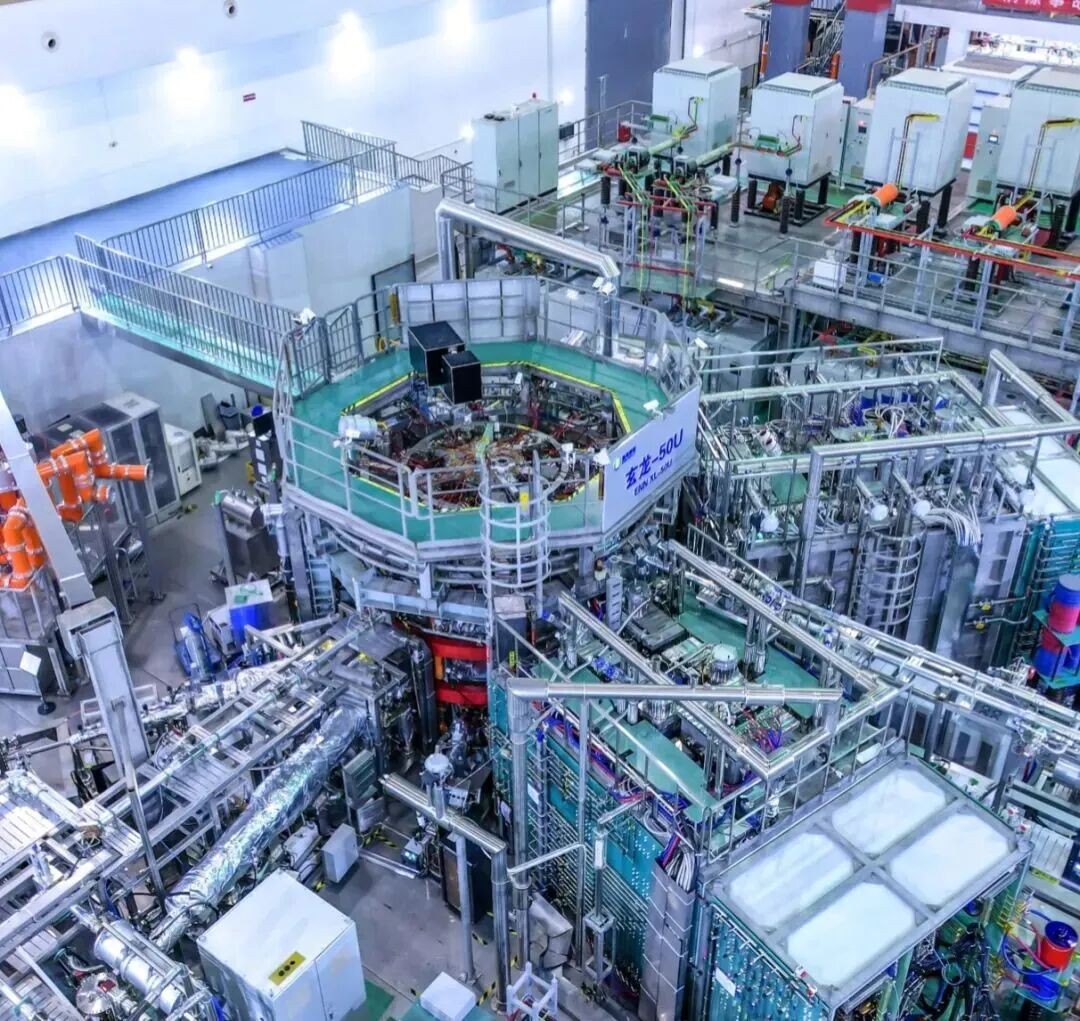
Hydrogen-boron fusion has commercialization advantages such as being neutron-free, having abundant and easily accessible fuel, and low cost. Its product is helium (α particles), but compared with deuterium-tritium fusion, it requires higher reaction temperature and triple product, and more demanding reaction conditions. In this experiment, the ENN fusion team, through the synergy of high-energy neutral beam injection and radio-frequency waves, greatly increased the non-thermal equilibrium fast proton fraction at the first resonance peak of the hydrogen-boron reaction, achieving a hydrogen-boron fusion reaction rate greater than 1.0E8/s. This indicates that ENN's hydrogen-boron fusion has entered the experimental stage related to burning plasma, marking a major breakthrough in China's multi-path fusion energy development.
More than ten authoritative fusion experts from research institutes and renowned universities in multiple countries around the world held a special review meeting on the results of this experiment and unanimously agreed that: this experiment achieved effective and reproducible measurement of the proton energy spectrum and the hydrogen-boron fusion reaction product α particles in a spherical torus device. The detection method is reliable and can support verification of hydrogen-boron fusion reactions. It is a milestone breakthrough in the innovative exploration and practice of hydrogen-boron fusion in spherical torus devices and has important value and contributions to global scientific research on magnetic confinement hydrogen-boron reactions.
ENN's fusion research and development takes commercialization implementation as its core driving force and systematically lays out five key technologies to address the core challenges of hydrogen-boron fusion: laying out hydrogen-boron reaction rate improvement technology to achieve "ignitable, high-gain" hydrogen-boron fusion through theoretical and experimental breakthroughs; developing high-parameter engineering technology to meet the engineering needs of commercial reactors; developing technologies related to high plasma temperature to meet the high reaction temperature requirements of hydrogen-boron fusion; developing direct power generation technology for the hydrogen-boron fusion product α particles to achieve efficient conversion of fusion energy into direct current electricity; developing fusion artificial intelligence technology to accelerate research and development speed and achieve intelligent steady-state operation of commercial reactors.
Looking to the future, ENN is implementing the commercialization of hydrogen-boron fusion through a "three-step" strategy: the first step is to achieve a hydrogen-boron fusion reaction by the end of 2026, and this goal has now been achieved ahead of schedule; the second step is to light the first lamp of hydrogen-boron fusion by 2030. The next-generation spherical torus device "Helong-2," which bears this mission, has already begun full-scale construction and is expected to be completed by the end of 2027; the third step is to achieve steady-state, high-power power generation before 2035 and enter the demonstration reactor stage.
Disclaimer: Information republished from partner media, institutions or other websites is provided for reference and communication purposes only. It does not imply endorsement of its views or verification of its accuracy. Please contact us if any content infringes rights or requires correction.