
Europe Completes Delivery of Final ITER Vacuum Vessel Sector, Marking Conclusion of 16 Years of Manufacturing
 Scan to share
Recently, Fusion for Energy (F4E), in collaboration with Ansaldo Nucleare, Westinghouse, and Walter Tosto, has completed the manufacturing of Europe's final vacuum vessel sector for the International Thermonuclear Experimental Reactor (ITER) and delivered it to the ITER project site at Cadarache in southeastern France.
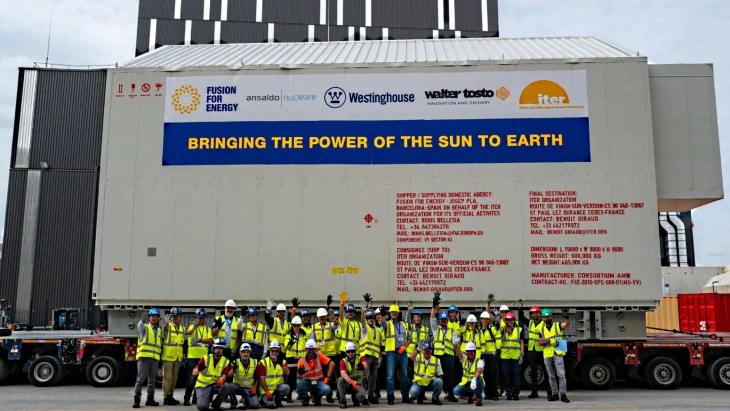
It is understood that the ITER vacuum vessel has an internal volume of 1,400 cubic meters and is composed of nine wedge-shaped steel sectors, each over 14 meters tall and weighing up to 440 tonnes. Once assembled, the vacuum vessel will have an outer diameter of 19.4 meters, a height of 11.4 meters, and weigh approximately 5,200 tonnes; after the installation of internal components such as the blanket and divertor, the total weight will reach 8,500 tonnes. Of the vacuum vessel sectors, Europe was responsible for five and South Korea for four. In 2016, the two parties reached a supplementary agreement under which South Korea manufactured two additional sectors originally belonging to the EU, and completed the delivery of four sectors in November 2024. This component is the last major component received at the ITER site, and this delivery marks the successful conclusion of 16 years of manufacturing work.
F4E Director Marc Lachaise stated that in the current fusion race, knowledge and professional expertise are of paramount importance. Thanks to the close collaboration of the consortium comprising F4E, Ansaldo Nucleare, Westinghouse, and Walter Tosto, and drawing on the experience of the ITER Korea project in component manufacturing. The final sector departed from Westinghouse's factory in Monfalcone, Italy, and was transported by DAHER to Cadarache, arriving safely at the ITER site via sea and land transport.
ITER aims to build a Tokamak fusion device to demonstrate the feasibility of fusion as a large-scale carbon-free energy source. Its goal is to operate at 500 megawatts with 50 megawatts of plasma heating power input for at least 400 seconds, and may require an additional 300 megawatts of electrical power input during operation; ITER itself will not produce electricity. 35 countries participate in the collaboration, with the European Union bearing nearly half of the construction cost, while China, India, Japan, South Korea, Russia, and the United States share the remainder equally. ITER construction began in 2010, and the first plasma operation has been delayed from the original plan of 2018; the revised schedule proposes achieving deuterium-deuterium fusion operation by 2035.
Disclaimer: Information republished from partner media, institutions or other websites is provided for reference and communication purposes only. It does not imply endorsement of its views or verification of its accuracy. Please contact us if any content infringes rights or requires correction.