
ITER Test Blanket Modules Enter Key Phase of Preliminary Design Review
 Scan to share
The International Thermonuclear Experimental Reactor (ITER) Test Blanket Module (TBM) project is advancing a key technology validation effort in the field of fusion energy. The Test Blanket Modules address the breeding blanket requirements of future fusion power plants, aiming to validate tritium breeding concepts under reactor operating conditions, providing a technical foundation for fusion fuel cycle self-sufficiency.
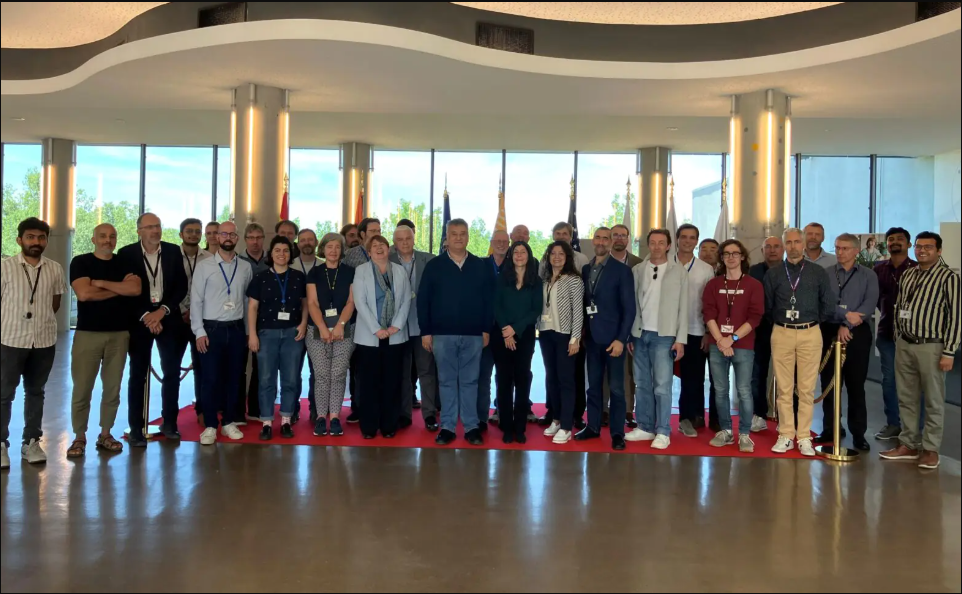
Group photo at the European TBM Preliminary Design Review meeting held at ITER Headquarters. F4E-ITER Organization
In a fusion reaction, deuterium and tritium fuse and release high-energy neutrons. When high-energy neutrons enter a lithium-containing blanket, they can interact with lithium to produce new tritium, which then re-enters the fuel cycle. Due to the scarcity of natural tritium resources, the breeding blanket is regarded as a critical in-vessel component for the long-term operation of future fusion power plants.
ITER provides a test platform that closely approximates reactor conditions for this technology. Under the TBM project arrangement, different organizations are designing four test blanket concepts. Among them, Europe is contributing to the development of two concepts: the Water-Cooled Lithium-Lead (WCLL) blanket led by the European Fusion for Energy organization (F4E), and the Helium-Cooled Ceramic Pebble Bed (HCCP) blanket developed in collaboration with Korea. These prototype blankets are scheduled to be installed and tested during ITER operation, enabling researchers to evaluate their performance under relevant operating conditions.
F4E recently held Preliminary Design Review (PDR) meetings for the two European TBM concepts. To support the reviews, the F4E team and its partners prepared more than 150 technical documents for each concept, covering design, safety, quality, and engineering analysis. These documents incorporate the outcomes of long-term technical exchanges with the ITER Organization, as well as analytical data provided by laboratories and suppliers.
Francesca Fantini, F4E Test Blanket Module Project Manager, stated that the TBM integrates advanced materials and multiple key technologies, and its design must meet stringent nuclear safety and quality requirements. She noted that the design builds on long-term research and development efforts by European fusion laboratories, which have provided multidisciplinary expertise, while the project team has also fed engineering experience back to research institutions for subsequent breeding blanket development.
Given the broad scope and high technical complexity of the TBM systems, project progress relies on multi-party collaboration. Experts from F4E, the Korean side, and the ITER Organization have coordinated technical solutions for years and have established a relatively stable working mechanism through this cooperation. Fantini stated that the parties discussed remaining issues and response plans at recent meetings, and are confident of completing the Preliminary Design Review by the end of the year.
Upon completion of the Preliminary Design Review, the F4E team will transition to the final design phase and proceed with new model development contracts. This work will further advance the Test Blanket Modules from scientific design toward engineering validation, and will also help Europe build and maintain professional capabilities in the breeding blanket, a key fusion technology area.
Disclaimer: Information republished from partner media, institutions or other websites is provided for reference and communication purposes only. It does not imply endorsement of its views or verification of its accuracy. Please contact us if any content infringes rights or requires correction.