
Austrian Startup Introduces Containerized Thorium-Based Reactor
 Scan to share
Recently, Austrian startup Emerald Horizon AG officially introduced its concept for a containerized accelerator-driven thorium-based subcritical micro modular reactor (SMRX). The company plans to adopt an "energy storage first" strategy, generating early revenue from batteries and molten salt energy storage before concurrently advancing the development and commercial deployment of its accelerator-driven thorium energy system (ADES).
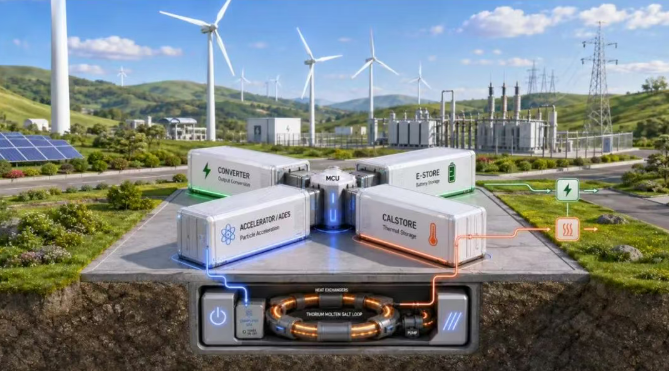
It is reported that the ADES system uses an external particle accelerator to drive a mixed fuel of thorium and fluoride salts, maintaining a subcritical operating state so that shutting down the accelerator immediately stops the reaction, with a rated electrical power of approximately 10 MW per module. To reduce heavy-asset manufacturing risks, Emerald Horizon has signed a joint development and manufacturing agreement with Dutch industrial group VDL Groep, planning to leverage its precision manufacturing capabilities for factory-scale batch production of micro-reactor containers, and intends to build a prototype in Eindhoven, the Netherlands, in 2029.
In terms of business model and economics, the company plans to provide integrated electricity and heat supply through 20-year "energy-as-a-service" lease contracts, with a target price of 8.5 euro cents per kWh, focusing on energy use scenarios such as data centers, heavy industry, hydrogen production, and remote areas. However, the project's technology readiness level is currently only 4.5, and it still faces major challenges in 1 MW molten salt loop testing, prototype funding (estimated at 75 million euros), and nuclear safety regulatory licensing and certification in various countries.
Although Austria itself maintains a cautious attitude toward nuclear energy, Emerald Horizon is actively expanding into international markets, not only conducting site selection and pre-licensing consultations with European countries such as the Netherlands and Slovakia, but also establishing a U.S. subsidiary and engaging with Idaho National Laboratory (INL) and law firms, striving to have its technology classified as a novel subcritical nuclear-related technology to accelerate regulatory approval.
Disclaimer: Information republished from partner media, institutions or other websites is provided for reference and communication purposes only. It does not imply endorsement of its views or verification of its accuracy. Please contact us if any content infringes rights or requires correction.