
After the Fusion Temperature Record: How Does General Fusion Turn Compression Experiments into Bankable Engineering?
 Scan to share
A fusion device has achieved a higher temperature—how much work remains before it becomes a power plant? In the quarterly business information released by General Fusion on November 16, the progress of the LM26 compression experiment, the funding status, and subsequent R&D targets were presented together. The company previously announced that the experiment achieved an electron temperature exceeding 1 keV. This is progress on a specific measurement subject and cannot yet be equated with fuel ions reaching the same temperature, let alone interpreted as net electrical output to the grid. Observing this temperature news alongside the company's R&D arrangements makes the true cost of fusion entrepreneurship clearer: every step forward requires physical evidence and equipment capability to be established in tandem.
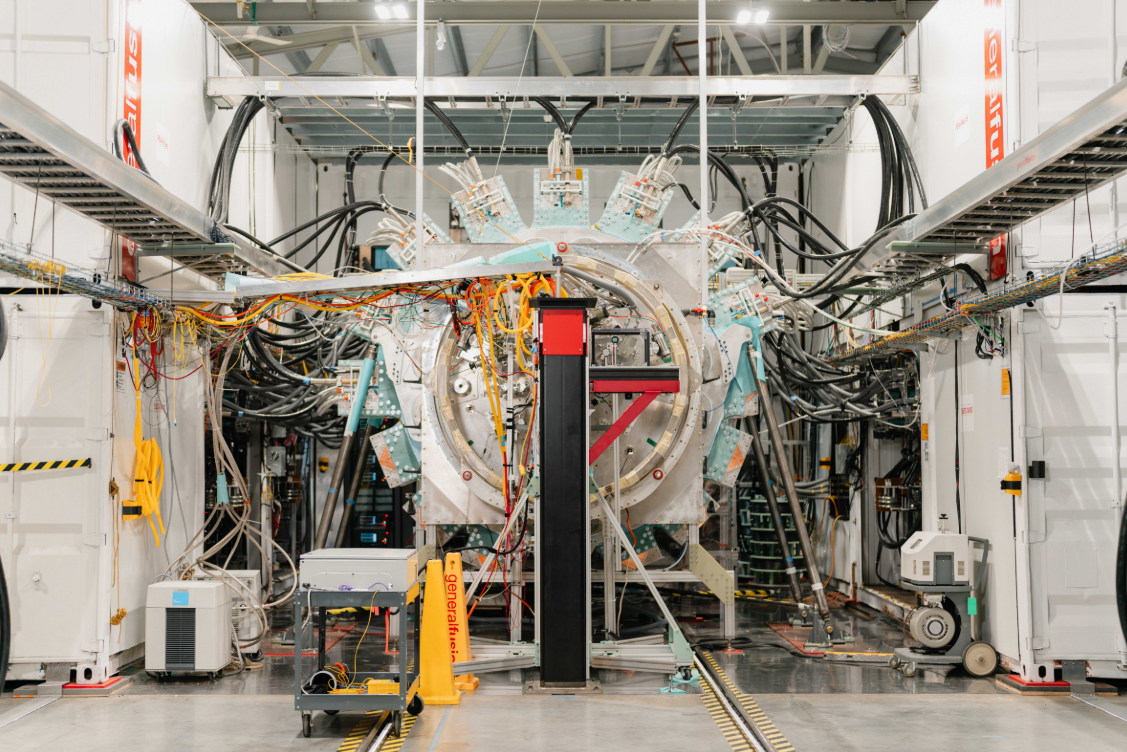
1. Compression Can Heat—Provided Energy Is Retained Long Enough
General Fusion adopts the Magnetized Target Fusion (MTF) approach. The basic idea is to first form a plasma confined by a magnetic field, then increase its temperature and density through mechanical compression. Compression does work on the plasma, similar to how compressing a gas raises its temperature, but a fusion device deals with a more complex conducting fluid. During compression, radiation, particle transport, and interactions with the boundary can all carry away energy; compressing faster and deeper also increases requirements on equipment and stability.
Temperature is therefore only part of the result. If energy is lost quickly, a higher instantaneous temperature may not correspond to effective fusion conditions; if density is insufficient, even hot particles may produce a limited number of reactions. The Lawson Criterion links temperature, density, and energy confinement, reminding researchers that a single peak value cannot determine whether a device is approaching self-sustaining burn. For pulsed compression approaches, these parameters change rapidly within a very short time, and diagnostic systems must resolve whether they meet requirements within the same period.
Moreover, the input energy in experiments does not come only from direct heating. Forming the plasma, driving the magnetic field, and the compression mechanism all require energy. Even if a future power plant achieves high fusion energy release, heat collection, electricity generation, and plant power consumption must still be accounted for before net electricity can be discussed. These gain metrics at different levels must not be conflated.
2. What Does an Electron Temperature of 1 keV Demonstrate?
The results announced by the company on October 8 pertain to electron temperature and state that diagnostic methods such as Thomson Scattering were used. The electronvolt (eV) is a unit of energy, and 1 keV corresponds to a temperature scale of approximately over ten million degrees Celsius. However, fusion reactions primarily involve ions, and energy exchange between electrons and ions takes time; especially in rapidly changing compression experiments, the two need not have the same temperature.
Therefore, this result supports that the compression heating approach has achieved stage-wise evidence in electron heating. To further characterize the fusion fuel state, ion temperature, density, confinement, and measurement uncertainty must all be supported together. The company also disclosed progress in ion heating, but qualitative descriptions cannot be supplemented as undisclosed ion temperature values. Public materials also mention that relevant papers have been submitted for peer review; submission itself is also different from completed independent academic scrutiny.
If subsequent experiments use deuterium-deuterium reactions to evaluate deuterium-tritium conditions, the extrapolation model and applicable boundaries must also be explained. Different reactions have different cross-sections, products, and heating feedback; being able to infer a certain fuel condition does not mean that condition has been achieved with that fuel. For industry observers, carefully distinguishing measured quantities from extrapolated quantities is far more meaningful than merging all results into a single high-temperature record.
3. Funding Can Support Experiments—But Does Not Mean Power Plant Construction Is Covered
The quarterly information shows that, as of the end of September 2026, the company held approximately $140.9 million in cash and short-term investments. Management expects existing funds to support LM26 R&D through the end of 2028; this is a judgment based on R&D plans and expenditure assumptions. It cannot be interpreted as meaning that all construction funds for a commercial fusion power plant are in place, nor can book funds be divided by some quarterly accounting loss to simply calculate how many years the project can run.
Compression experiments and power plant construction use funds in different ways. The former can modify equipment around a single experiment, adjust parameters, and operate intermittently; the latter must incorporate fuel systems, shielding, maintenance, power generation equipment, and safety facilities into continuous operating conditions. After an experimental platform proves a physical process feasible, new capital demands often emerge: scaling up equipment, improving repeat operation capability, supplementing materials and thermal engineering tests, and establishing a supply chain capable of repeat manufacturing.
This is also why financing news must be read alongside engineering milestones. The company's proposed timeline for a first power plant is a corporate target; current public results do not provide an electricity cost at which users could sign contracts. Even if certain expensive equipment is reduced in the future, it cannot be directly assumed that the entire power plant will be cheap, because compression actuators, maintenance frequency, and downtime may become new sources of cost.
4. What Truly Affects Electricity Price Is Whether It Can Run Again After Compression
The magnetized target approach hopes to combine compression, energy capture, and future liquid metal schemes, but it cannot be concluded from this that LM26 has already demonstrated the full thermal cycle of a commercial power plant. Engineering must ask: how is the compression boundary restored, after how many load cycles do components need replacement, and how is the released heat stably delivered to the power system. A single experiment can tolerate longer preparation time, but a power plant needs enough effective operating hours to amortize investment.
These questions will gradually shift R&D focus from maximum parameters to repeatability. A single result needs to be reproduced, and multiple experiments need to explain the degree of dispersion; after reproducibility is achieved, the energy consumption and maintenance cost of each cycle must also be measured. If higher performance must rely on frequent inspection or replacement of key components, the generation-side benefits may be offset by operating costs.
To evaluate General Fusion's next-stage progress, electron and ion states, energy losses during compression, and equipment repeat operation capability should be placed on the same evidence table. The funding balance can buy time for experiments, but cannot replace these results. Only when stably reproducible physical performance and an acceptable maintenance cadence appear simultaneously will compression fusion begin to have the conditions to move from an R&D project to a power generation asset.
(This article is based on General Fusion's quarterly business disclosures, LM26 experimental descriptions, and related collaborative research information, and was independently written after AI-assisted organization, aiming to explain the relationship among fusion measurement results, engineering validation, and corporate financing. Experimental data mainly come from the developer's public materials. The text strictly distinguishes electron temperature, fuel ion states, model extrapolation, and net power generation; the company's timeline is not treated as achieved engineering results.)
Disclaimer: Information republished from partner media, institutions or other websites is provided for reference and communication purposes only. It does not imply endorsement of its views or verification of its accuracy. Please contact us if any content infringes rights or requires correction.