
Seychelles Leverages Nuclear Technology to Improve Soil Management and Boost Fruit and Vegetable Production Capacity
 Scan to share
With the support of the International Atomic Energy Agency (IAEA), researchers in Seychelles are collaborating with policymakers and farmers to utilize nuclear and isotopic techniques. These methods aim to improve soil nutrient and water management, thereby boosting fruit and vegetable yields and strengthening local food production capacity.
Agricultural production in Seychelles has long faced challenges such as poor soil fertility. To increase crop yields, local farmers previously relied heavily on expensive chemical fertilizers and large amounts of irrigation water. Now, researchers are helping farmers gain a more accurate understanding of their land through soil analysis and providing guidance on fertilizer use and irrigation management, making agricultural inputs more sustainable and cost-effective.
Roy Govinden, Chief Agricultural Scientist at the Seychelles Ministry of Agriculture and a former IAEA technical cooperation fellow, stated that this support has enabled Seychelles to use nuclear technology and innovative approaches to improve soil health, enhance agricultural resilience, and promote sustainable agricultural production.
Currently, researchers in Seychelles are investigating nature-based solutions, including organic soil amendments and biofertilizers. Scientific analysis has led to the use of organic manure from poultry and cattle to boost soil nutrient levels, promoting healthy papaya growth and increasing fruit yields.
Paramsothy Jeyakumar, a soil scientist and plant nutritionist at the Joint FAO/IAEA Centre of Nuclear Techniques in Food and Agriculture, noted that nuclear and isotopic techniques provide accurate data on soil and water characteristics, helping researchers design and implement effective nature-based solutions.
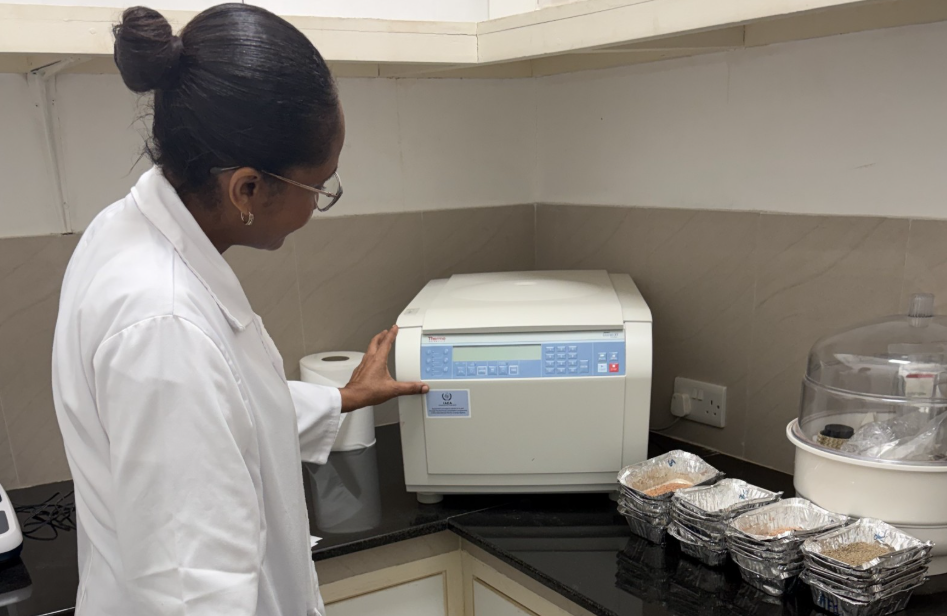
With this support, the Soil and Plant Diagnostic Laboratory and the Crop Research and Development Station of the Seychelles Agricultural Agency have been equipped with new instruments. They are advancing research into soil fertility management, the development of local bio-based fertilizers, and the sustainable use of natural resources. The Soil and Plant Diagnostic Laboratory was established in 2013 with IAEA support.
Healthy plant growth depends on a balance of soil nutrients, including adequate nitrogen. Laboratory staff have mastered specialized methods using nitrogen-15 technology to track fertilizer uptake. Subsequent research has also utilized nitrogen-15 labeled fertilizers in trials with sweet peppers, providing valuable insights for optimizing soil nutrient management. To address the issue of soil salinization facing the island nation, the International Atomic Energy Agency (IAEA) provided training to two researchers on the precise monitoring of soil salinity using cosmic-ray neutron sensors, gamma-ray spectrometers, and remote sensing technologies. Researchers also conducted studies on salinity management, and farmers in coastal areas have adopted the resulting recommendations to improve the management of saline soils and sustain crop production.
With the support of the IAEA’s technical cooperation program and the Joint FAO/IAEA Centre, Seychelles is applying nuclear technology to agricultural practices, providing a scientific basis for soil improvement, water-saving irrigation, and increased crop yields.
Disclaimer: Information republished from partner media, institutions or other websites is provided for reference and communication purposes only. It does not imply endorsement of its views or verification of its accuracy. Please contact us if any content infringes rights or requires correction.