
Synchrotron radiation reveals mechanism of acidophilic microalga PM01 tolerating high-concentration manganese
 Scan to share
Researchers have used synchrotron radiation techniques to reveal the key mechanism by which an acidophilic green microalga survives in high-concentration manganese environments. The research subject is the acidophilic alga C. acidophila PM01, originally isolated from an acid mine drainage pond, which can survive at manganese concentrations up to 50 mM (approximately 2.75 g/L), making it one of the most manganese-tolerant microalgae reported to date.
Manganese is a nutrient element required by organisms, but during processes such as mining, ore processing, and electrolytic manganese production, high concentrations of manganese can enter water bodies and cause pollution. In particular, manganese removal is difficult in acidic waters. Some microorganisms can adapt to such extreme environments, but their tolerance mechanisms still require fine analytical tools to elucidate.
To decipher the survival strategy of PM01, the research team conducted experiments at the Elettra Synchrotron Light Source in Trieste, Italy, employing a combination of low-energy X-ray fluorescence microscopy (XRF), scanning transmission X-ray microscopy (STXM), X-ray absorption near-edge structure (XANES) spectroscopy, and synchrotron radiation Fourier-transform infrared spectromicroscopy (SR-FTIR). These methods were used to observe the distribution of key elements within cells, identify cellular structural features, determine the chemical speciation of manganese, and analyze the biochemical responses of cells under manganese exposure, respectively.
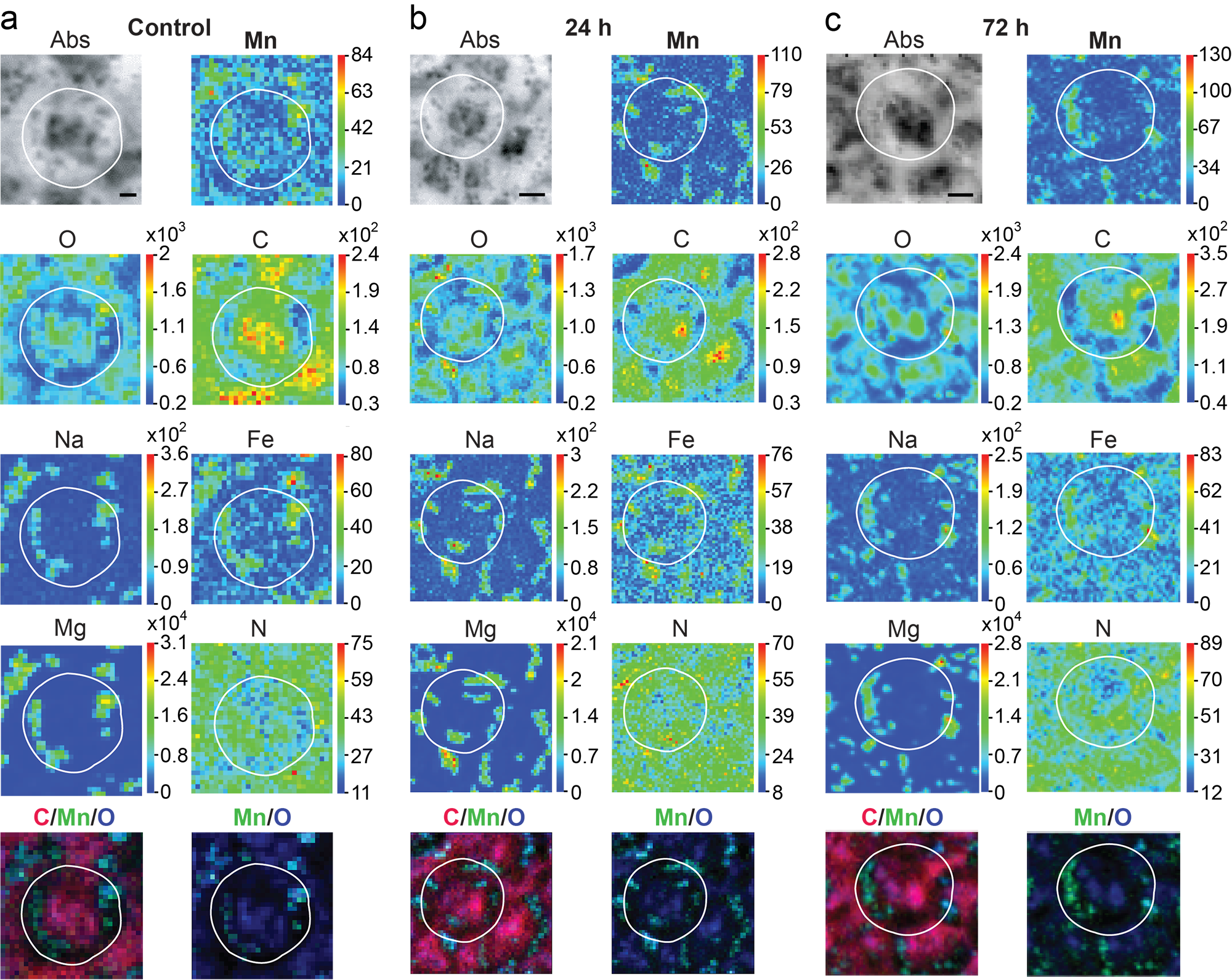
Characteristic LE-µXFM and STXM absorption micrographs of C. acidophila PM01 cells at 400 nm spatial resolution, untreated (control) or treated with 20 mM MnCl 2 for 24 h or 72 h
The experimental results showed that manganese did not accumulate uniformly within PM01 cells but was mainly distributed in oxygen-rich regions around the nucleus and at the cell periphery. This distribution pattern is consistent with vacuolar sequestration of manganese, suggesting that the cell may reduce the impact of manganese on critical cellular structures and metabolic processes by confining it to relatively safe compartments.
XANES analysis further indicated that manganese entering the biomass remained in the Mn²⁺ oxidation state and was primarily surrounded by oxygen-containing ligands in an approximately octahedral geometry. Complementary measurements suggested that phosphate may play an important role in manganese binding within vacuoles and cell walls.

(a) XANES spectra of Mn in C. acidophila PM01 biomass and (b) SR-FTIR analysis of biomolecular signatures (fingerprint region provided)
SR-FTIR results revealed changes at the cellular metabolic level, including alterations in carbohydrate- and phosphate-related signals, reduced lipid reserves, and signs of mild oxidative damage. Combined with microscopic observations and photosynthesis measurements, the study suggests that PM01 requires considerable energy to resist high manganese concentrations. The cell copes with manganese stress by reallocating metabolic reserves, expanding the vacuolar system, and slightly enhancing photosynthetic efficiency.
Based on these findings, the research team proposed that PM01's metal tolerance mode can be summarized as "survival through low intracellular retention." That is, rather than relying on extensive manganese accumulation, this microalga binds a portion of manganese to the cell surface, sequesters another portion into vacuoles, and may further expel it through vacuolar excretion, thereby keeping manganese as far as possible from sensitive cellular machinery.
This finding has implications for the application of microalgae in manganese-contaminated acidic waters. Since PM01 accumulates relatively low amounts of manganese, it may not be an ideal candidate for manganese bioremediation; however, its outstanding tolerance suggests that cultivating this microalga in manganese-contaminated acidic waters could be used for biomass and biofuel production while reducing dependence on freshwater resources. The study also provides a direction for further exploring whether other acidophilic microalgae employ similar "rejection" strategies to resist metal stress.
Disclaimer: Information republished from partner media, institutions or other websites is provided for reference and communication purposes only. It does not imply endorsement of its views or verification of its accuracy. Please contact us if any content infringes rights or requires correction.