
Search Results
Keyword:nuclear materials

Brookhaven National Laboratory Develops Integrated X-ray Imaging Tool for Nuclear Materials Research
A research team at the U.S. Department of Energy's Brookhaven National Laboratory has recently developed and built a new experimental apparatus that integrates four X-ray computed tomography techniques into a single instrument, enabling multiscale, comprehensive studies of next-generation nuclear reactor materials. The related technical achievements and capability demonstration have been published in the Journal of Synchrotron Radiation. The apparatus is located at the X-ray Powder Diffraction (XPD) beamline of the National Synchrotron Light Source II (NSLS-II) and was commissioned jointly by the U.S. Department of Energy Office of Nuclear Energy's Nuclear Science User Facilities program, Brookhaven National Laboratory's Nuclear Science and Security Department, and NSLS-II. Researchers said that next...
2026-09-12
IAEA Launches New Project to Enhance Nuclear Fuel and Materials Testing Capabilities in Research Reactors
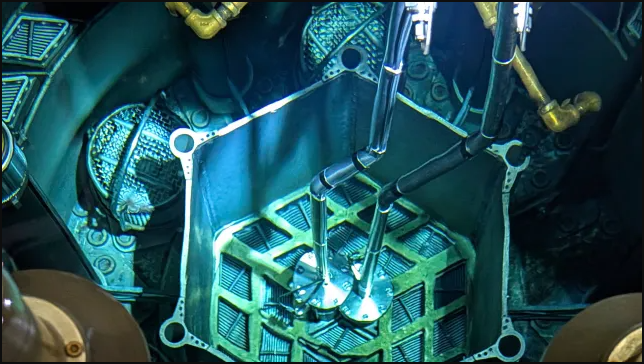
The International Atomic Energy Agency (IAEA) recently launched a four-year coordinated research project aimed at optimizing the experimental design of nuclear fuel and structural materials testing in research reactors, enhancing the safety, effectiveness, and efficiency of irradiation experiments. Top view showing a materials testing reactor core loaded with two in-core materials testing devices. (Photo: Y. Ostrovsky/MIT) With the continued advancement of new nuclear reactor technologies, growing interest in small modular reactors, and existing nuclear power plants seeking long-term operation, the demand for reliable testing of new nuclear fuels and structural materials is increasing. Before being put into use in nuclear reactors, these fuels and materials must be tested and qualified under harsh conditions such as radiation and high temperatures...
2026-08-21

SHINE Joins GE Vernova-Led Project to Modernize Nuclear Fuel Reprocessing Materials Accountability
SHINE Technologies (SHINE) announced on August 18 that it has joined a nuclear fuel reprocessing materials management project led by GE Vernova (GE Vernova), with both parties collaborating on tracking, measurement, and nuclear materials accountability of spent fuel during the reprocessing process. The project is led by GE Vernova's Advanced Research Center and funded by the U.S. Department of Energy's Advanced Research Projects Agency-Energy (ARPA-E), with the goal of introducing artificial intelligence technologies into reprocessing facilities to improve real-time monitoring of spent fuel flow and the efficiency of nuclear materials accounting. As a subcontractor to GE Vernova, SHINE will participate in improving sensor deployment schemes and developing an AI-supported materials tracking system, ensuring that nuclear materials control and accountability requirements are incorporated into the overall design at the early stages of reprocessing facility development.
2026-08-19
Kazakhstan's National Nuclear Center Advances Material Testing Research for Future Reactors
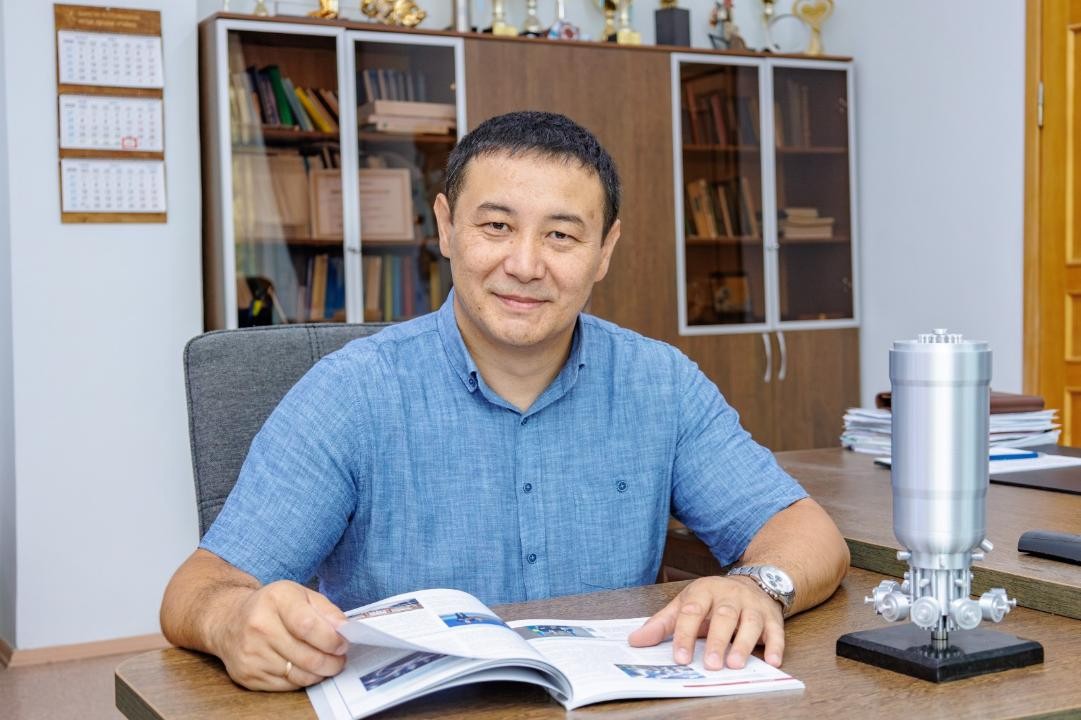
On August 11, the National Nuclear Center of the Republic of Kazakhstan presented its progress in research on structural materials for advanced reactors. Yerzhan Ernatuly Sapataev, head of the Radiation Materials Science Laboratory at the center's Institute of Atomic Energy, stated that the development of next-generation reactors and fusion technologies has imposed higher requirements on structural materials in terms of high-temperature resistance, radiation tolerance, and corrosion resistance, and that material reliability will directly determine the safety and service life of future nuclear energy systems. Materials inside future reactors typically need to...
2026-08-12
Syria Confirms IAEA Delegation to Visit Damascus for Talks on Nuclear Material Handling and Peaceful Use Cooperation
The Syrian Atomic Energy Commission issued a written statement confirming that a delegation from the International Atomic Energy Agency (IAEA) will arrive in Damascus in the coming days to discuss progress in Syria's nuclear energy sector and international nuclear cooperation. The visit was announced following reports that the IAEA is preparing to remove nuclear materials from secret facilities in Syria. The statement said Syria is cooperating with the United States and friendly countries on addressing the nuclear legacy left by the former regime, and is committed to promoting the peaceful use of nuclear energy in fields such as health, food, and scientific research. The statement noted that Syria is working to activate its full membership status in the IAEA, and emphasized that Syria, after liberation, has...
2026-08-12

Three U.S. Nuclear Energy Companies Explore Manufacturing Next-Generation Reactor Fuel from Recycled Nuclear Materials
U.S. nuclear energy companies Curio, NuScale Power, and Framatome have signed a memorandum of understanding to evaluate the feasibility of converting recycled nuclear materials into next-generation reactor fuel and related products. The tri-party collaboration is not focused on immediate commercial production, but rather on research into technical feasibility, fuel development, manufacturing capabilities, supply chain integration, and future commercial deployment, seeking to connect spent fuel recycling, fuel fabrication, and advanced reactor applications into a more complete industrial chain. Under this collaboration, Curio will provide its NuCycle nuclear fuel recycling technology, aiming to recover reusable strategic nuclear materials from spent fuel, with claims of reducing residual waste volume by up to 97%.
2026-08-07
Basic research cracks an application challenge that has persisted for nearly half a century: quantitative prediction of neutron irradiation swelling via ion irradiation
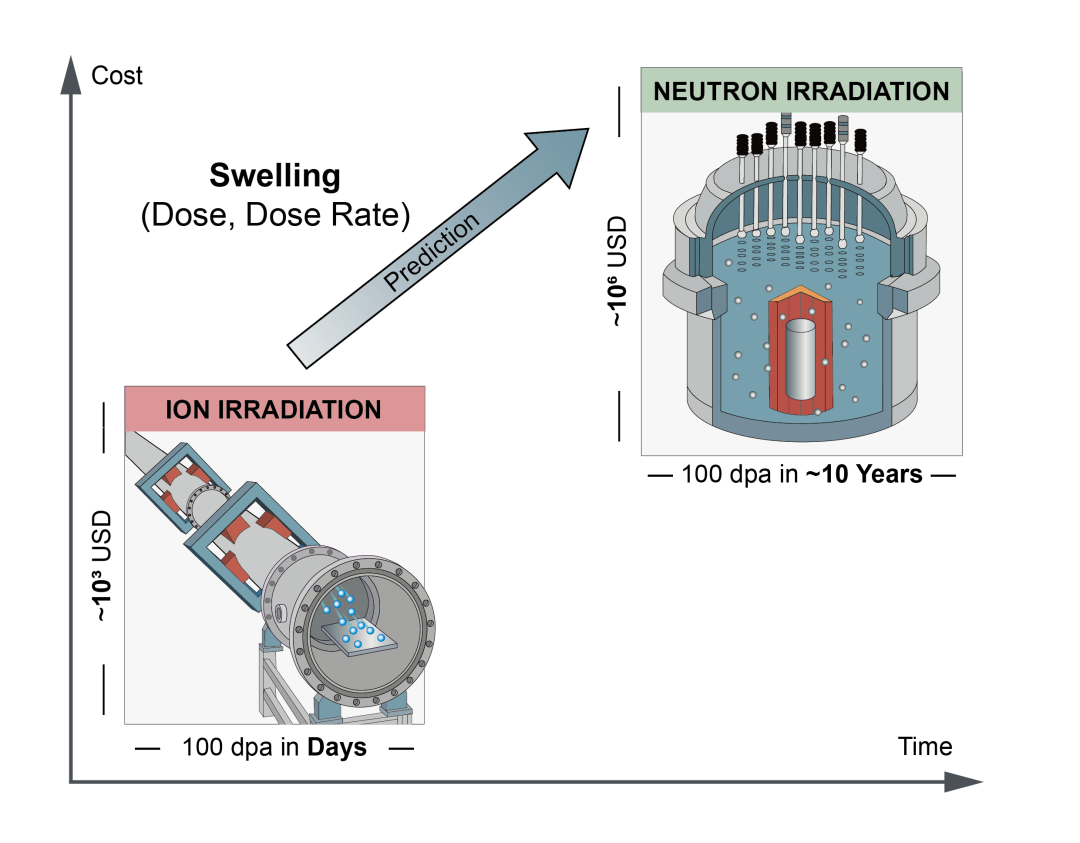
Whether advanced nuclear energy systems can operate safely over the long term depends on the ability of structural materials to resist neutron irradiation damage. Neutrons create numerous atomic-scale defects in materials, which gradually aggregate into nanoscale cavities, ultimately causing material swelling, dimensional instability, and performance degradation. However, obtaining high-dose neutron irradiation data often requires years or even more than a decade, with high costs and post-irradiation sample radioactivity; in contrast, ion irradiation can simulate years of accumulated damage within days and is therefore widely adopted (approximately 95% of irradiation experimental data in existing literature come from ion irradiation). But the dose rate of ion irradiation is typically 3—4 orders of magnitude higher than that of neutron irradiation, making direct conversion between the two results difficult. Recently, the research team of Wang Chenxu and Wang Yugang from the Institute of Heavy Ion Physics, School of Physics, and the State Key Laboratory of Nuclear Physics and Nuclear Technology at Peking University, in collaboration with researchers from the University of Tennessee and other institutions, established a quantitative relationship between material swelling and irradiation dose and dose rate at fixed temperatures based on cluster dynamics simulations, theoretical derivations, and ion irradiation experiments, achieving prediction of neutron irradiation swelling using rapid ion irradiation and providing a new tool for rapid screening and lifetime evaluation of nuclear materials.
2026-08-07

Two Advanced Materials Research Projects by 1st American Nuclear Co. Supported by U.S. Department of Energy Nuclear Science User Facilities Program
1st American Nuclear Co. (FANCO) announced on August 3 that two research proposals submitted by its scientists have been selected for support under the Nuclear Science User Facilities (NSUF) program of the U.S. Department of Energy Office of Nuclear Energy. Both selected projects come from the NSUF Fiscal Year 2026 Rapid Turnaround Experiment (RTE) review cycle, with research focused on next-generation reactor materials and fuel-related issues. The NSUF Rapid Turnaround Experiment program is open to nuclear energy researchers and primarily provides irradiation testing, post-irradiation examination capabilities, and related technical support...
2026-08-06