
U.S. Department of Energy Selects Fermilab to Lead AI Project to Enhance Superconducting Radio-Frequency Cavity Control in Particle Accelerators
 Scan to share
The U.S. Department of Energy's "Genesis Program" recently selected an artificial intelligence project led by Fermi National Accelerator Laboratory, supporting its collaboration with national laboratories, universities, and industry to use AI and machine learning technologies to improve resonance control in particle accelerators. The project aims to enhance accelerator operational performance and beam stability while reducing energy consumption and operating costs.
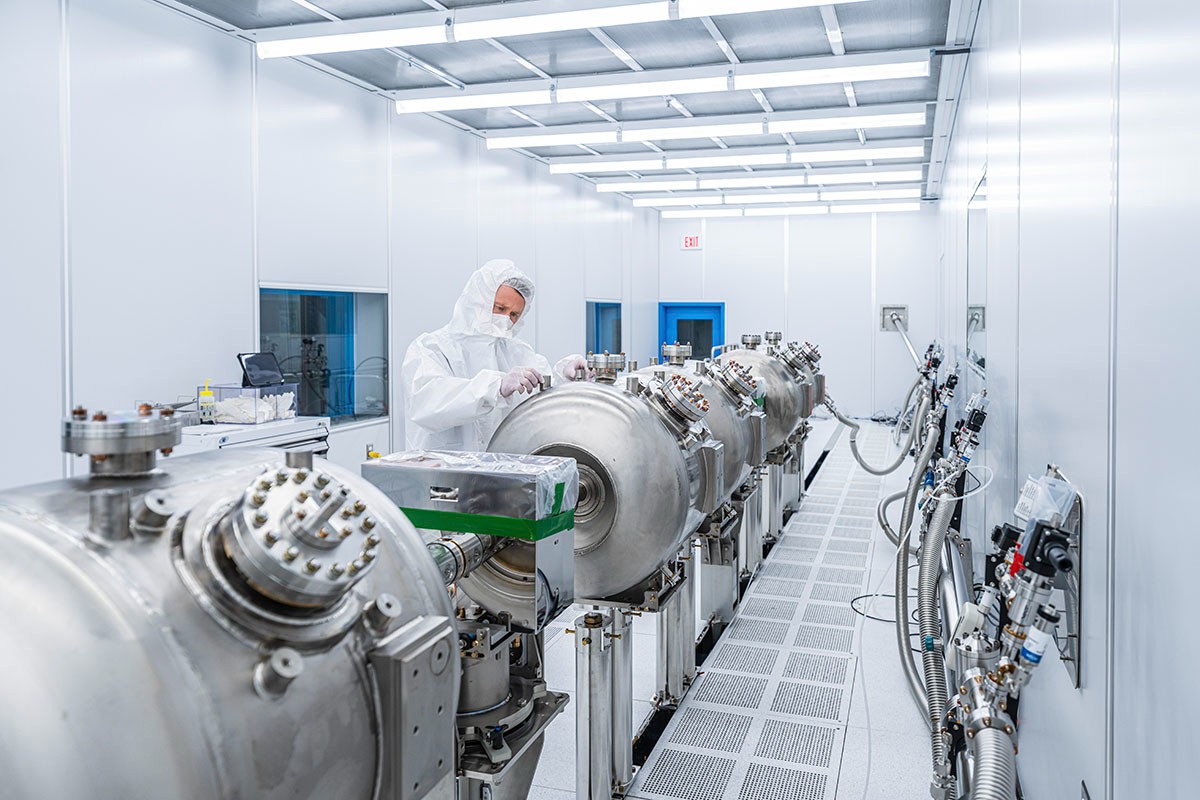
Superconducting radio-frequency cavities are being assembled and tested, ready for installation on the Proton Improvement Plan-II at the Fermilab Accelerator Complex. By finely tuning the resonant frequency of the cavities, scientists can optimize accelerator performance. Image credit: Fermilab Ryan Postel
Modern high-energy physics research relies heavily on particle accelerators. Many advanced accelerators use superconducting radio-frequency cavities to transfer electromagnetic energy to particle beams, precisely tuning the resonant frequency so that particles are accelerated at the right moment. Factors such as liquid helium pressure variations, electromagnetic field fluctuations, and vibrations from surrounding equipment can cause cavity frequency shifts, reducing energy transfer efficiency and potentially causing beam interruptions.
Under the project's vision, the research team will develop artificial intelligence and machine learning algorithms that enable control systems to continuously learn from changing operating environments, automatically reducing the impact of disturbances on resonant frequency. For large accelerators containing hundreds of superconducting radio-frequency cavities, this type of adaptive control is expected to improve tuning precision, reduce unnecessary power consumption, and enhance equipment operational reliability.
One of the primary application targets of this research is Fermilab's Proton Improvement Plan-II (PIP-II) accelerator. PIP-II will provide intense neutrino beams for the Deep Underground Neutrino Experiment at the Long-Baseline Neutrino Facility in the future. The project team hopes to verify whether introducing artificial intelligence into existing control equipment can support more stable operation of PIP-II in pulsed mode, thereby reducing average power, cooling costs, and equipment wear, while minimizing unscheduled downtime.
In addition to Fermilab, participating institutions in the project include Lawrence Berkeley National Laboratory, SLAC National Accelerator Laboratory, Argonne National Laboratory, Cornell University, Michigan State University, Toyota Technological Institute at Chicago, University of Michigan, Japan's High Energy Accelerator Research Organization (KEK), and xLight Corporation. The project also plans to establish a common resonance control data framework to facilitate data sharing among different superconducting radio-frequency accelerators and to cultivate talent at the intersection of artificial intelligence, machine learning, and low-level RF engineering.
Disclaimer: Information republished from partner media, institutions or other websites is provided for reference and communication purposes only. It does not imply endorsement of its views or verification of its accuracy. Please contact us if any content infringes rights or requires correction.