
Search Results
Keyword:neutron
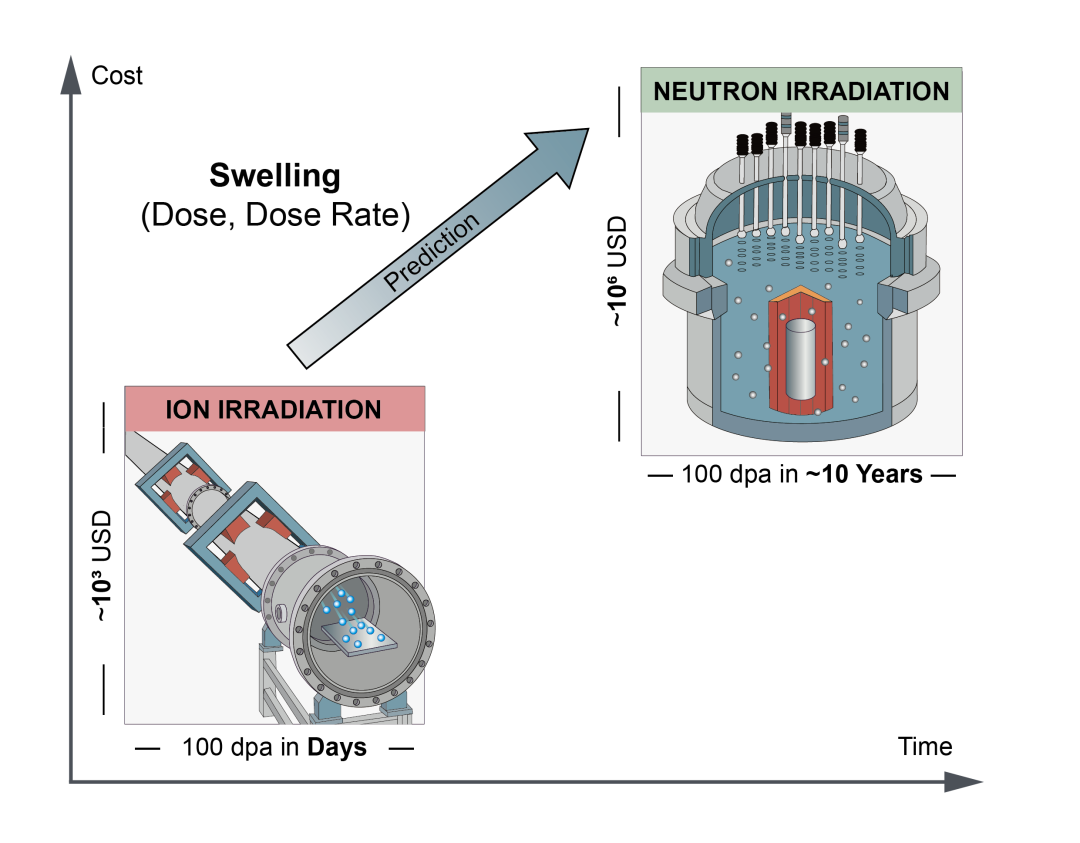
Basic research cracks an application challenge that has persisted for nearly half a century: quantitative prediction of neutron irradiation swelling via ion irradiation
Whether advanced nuclear energy systems can operate safely over the long term depends on the ability of structural materials to resist neutron irradiation damage. Neutrons create numerous atomic-scale defects in materials, which gradually aggregate into nanoscale cavities, ultimately causing material swelling, dimensional instability, and performance degradation. However, obtaining high-dose neutron irradiation data often requires years or even more than a decade, with high costs and post-irradiation sample radioactivity; in contrast, ion irradiation can simulate years of accumulated damage within days and is therefore widely adopted (approximately 95% of irradiation experimental data in existing literature come from ion irradiation). But the dose rate of ion irradiation is typically 3—4 orders of magnitude higher than that of neutron irradiation, making direct conversion between the two results difficult. Recently, the research team of Wang Chenxu and Wang Yugang from the Institute of Heavy Ion Physics, School of Physics, and the State Key Laboratory of Nuclear Physics and Nuclear Technology at Peking University, in collaboration with researchers from the University of Tennessee and other institutions, established a quantitative relationship between material swelling and irradiation dose and dose rate at fixed temperatures based on cluster dynamics simulations, theoretical derivations, and ion irradiation experiments, achieving prediction of neutron irradiation swelling using rapid ion irradiation and providing a new tool for rapid screening and lifetime evaluation of nuclear materials.
2026-08-07

First American Nuclear Company (FANCO) Receives DOE Funding to Accelerate Advanced Nuclear Reactor Development
First American Nuclear Company (FANCO) has received two Rapid Turnaround Experiment (RTE) awards from the U.S. Department of Energy's Office of Nuclear Energy, enabling the company to leverage specialized national laboratory research capabilities to support the development of its EAGL-1 small modular reactor. These awards were granted during the FY2026 RTE selection cycle, which evaluates proposals based on technical superiority, feasibility, and relevance to DOE's nuclear energy programs. The program provides researchers with free access to radiation testing, post-irradiation examination facilities, and technical expertise. FANCO-approved research projects include a study on the effects of extrusion temperature on FeCrAl-ODS alloys in liquid metal fast...
2026-08-06
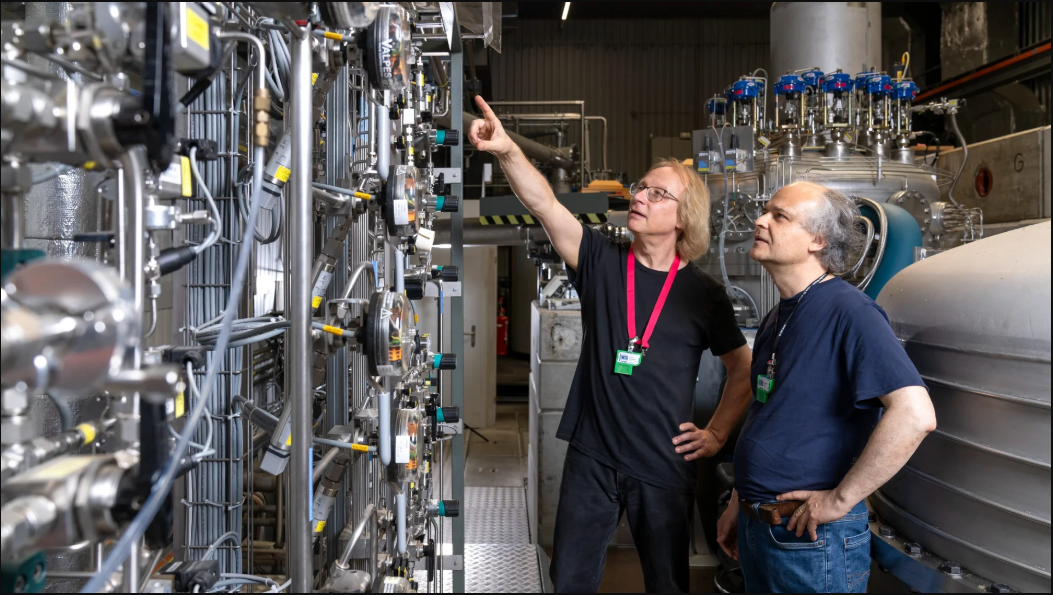
Swiss PSI Ultracold Neutron Experiment Finds No Signs of "Mirror World" Oscillation
The Paul Scherrer Institute (PSI) in Switzerland announced on July 28 that its researchers detected approximately 25 billion neutrons in an ultracold neutron experiment and found no signs of neutrons spontaneously transforming into mirror neutrons. The results constrain, with high certainty, the theoretical possibility of neutrons disappearing into the so-called mirror world. The mirror world hypothesis posits that every elementary particle in the real world may have a corresponding mirror particle, such as mirror electrons, mirror protons, and mirror neutrons. Such particles interact extremely weakly with ordinary matter, potentially connecting primarily through gravity or rare oscillations of neutral particles, and have therefore also been considered as dark matter candidates...
2026-08-03
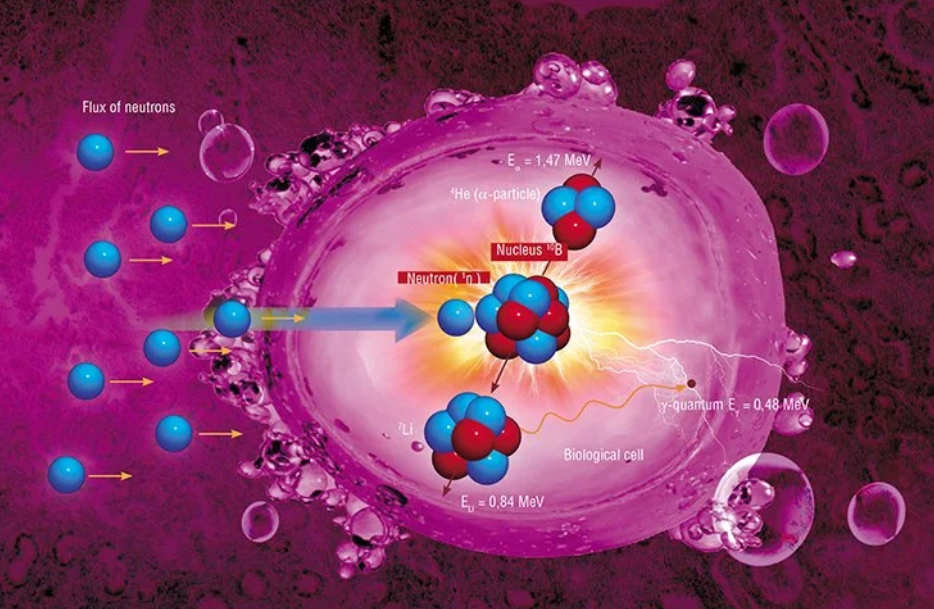
Russia's Vector Research Center Proposes Quantum Dots for Boron Delivery in Neutron Capture Therapy
Russia's Vector Research Center has proposed using quantum dots as targeted boron delivery systems in boron neutron capture therapy (BNCT) to explore more precise approaches to tumor treatment. Yuri Tumanov, the center's chief researcher, presented this research progress at a conference on engineering biology and biopharmaceuticals. Boron neutron capture therapy is a cancer treatment method that combines boron-containing drugs with neutron irradiation. The basic concept involves first allowing boron-containing drugs to accumulate in tumor cells, then subjecting the patient to neutron irradiation, which triggers a nuclear reaction that releases energy concentrated within boron-containing cancer cells, thereby destroying tumor cells. How to construct boron delivery systems that are low-toxicity, highly efficient, and capable of participating in targeted tumor destruction remains one of the key challenges in this field...
2026-08-01

Hefei establishes a new joint laboratory for fusion reactor material irradiation and evaluation, driving the coordinated development of the nuclear fusion industry.
Recently, the Joint Laboratory for Fusion Reactor Material Irradiation and Evaluation—co-established by the Institute of Plasma Physics (Hefei Institutes of Physical Science, Chinese Academy of Sciences) and the Institute of High Energy Physics (Chinese A
2026-07-27

China and Russia Discuss Cooperation on Non-Energy Applications of Nuclear Technology in Beijing
On July 24, Rosatom hosted a Russian-Chinese business matchmaking event in Beijing, focusing on cooperation in the non-energy applications of nuclear technology. Held at the Trade Representation of the Russian Federation in China, the event was attended b
2026-07-27