Registration
REGISTER FOR THE CONFERENCE
Registration
REGISTER FOR THE CONFERENCE
 Apply to Exhibit
APPLICATION FOR EXHIBITION
Apply to Exhibit
APPLICATION FOR EXHIBITION
 Sponsorship
SPONSORSHIP APPLICATION
Sponsorship
SPONSORSHIP APPLICATION

Nuclear-Powered Aircraft Carrier USS John F. Kennedy Completes Acceptance Sea Trials
Huntington Ingalls Industries (HII) announced on August 15 that its subsidiary Newport News Shipbuilding (NNS) has successfully completed acceptance sea trials for the second Gerald R. Ford-class nuclear-powered aircraft carrier, USS John F. Kennedy (CVN 79). USS John F. Kennedy conducted further testing and evaluation of critical ship systems and components at sea before returning to Newport News Shipbuilding. Earlier this year, the carrier had completed builder's sea trials. Derek Murphy, NNS vice president in charge of the new carrier construction program, stated that the carrier...
2026-08-17

India Unveils Nuclear Energy Self-Reliance Roadmap, Targeting 100 GW Nuclear Capacity by 2047
2026-08-17
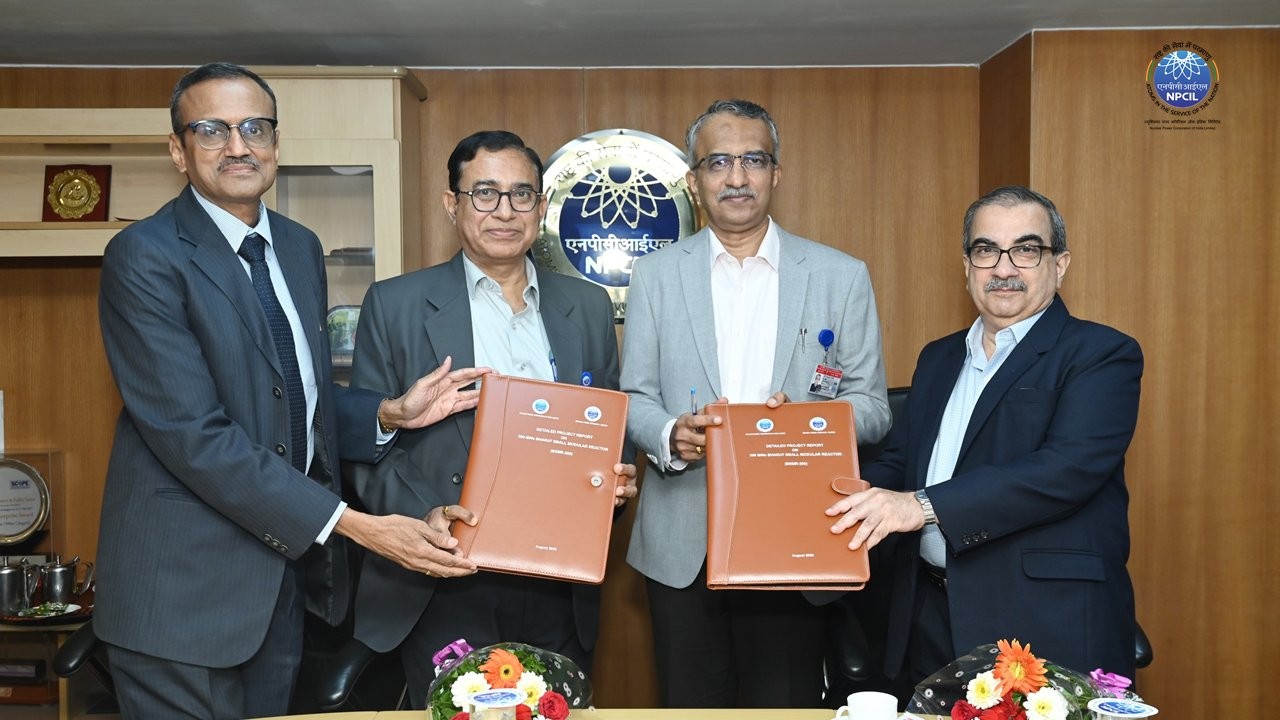
India Releases Detailed Project Report for 300 MWe Bharat Small Modular Reactor
2026-08-17

First Concrete Pour Initiated for ECCS Sump of Units 1 & 2 at Gorakhpur Nuclear Power Plant, India
2026-08-17

Russia to Develop General Safety Rules for Controlled Thermonuclear Fusion Facilities
2026-08-17

U.S. Fusion Company Discloses Texatron Platform Progress and Capital Markets Plans
2026-08-17
Vietnam Electricity Advances Preparatory Work for Ninh Thuan 1 Nuclear Power Plant
2026-08-17

Adani Group in Talks with Odisha on Nuclear Power Projects, Plans Two 3,000 MW Clean Energy Facilities
2026-08-17

India Releases Draft Rules Accompanying SHANTI Act, Requiring Nuclear Power Operators to Provide Nuclear Damage Insurance or Financial Guarantees
2026-08-17
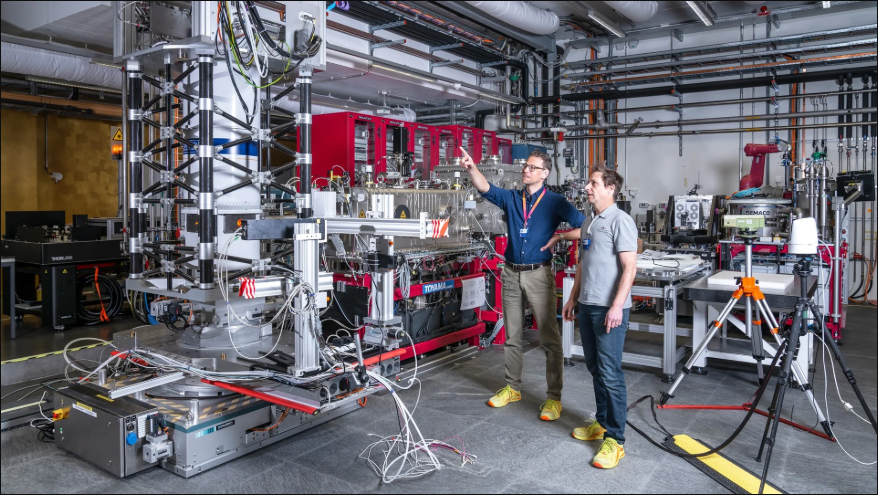
Researchers at the Paul Scherrer Institute (PSI) in Switzerland recently reported that the Cristallina experimental station of the Swiss Free-Electron Laser (SwissFEL) can now observe quantum states that only emerge at extremely low temperatures using X-ray scattering at temperatures close to absolute zero. Simon Gerber (left) and Bill Pedrini (right) at the Cristallina experimental station of SwissFEL. With the help of a custom-built cryostat connected to the beamline (far left), quantum states can now be studied at extremely low temperatures. Paul Scherrer Institute PSI/Markus FischerAccording to the team, they recently achieved a low temperature of 35 millikelvin in experiments...
2026-08-17
An international team of researchers from Denmark, Sweden, and Switzerland recently conducted a three-dimensional non-destructive analysis of a slice of the Martian meteorite NWA 7034 "Black Beauty" using neutron tomography and X-ray tomography, discovering macroscopic hydrogen-rich regions within it. The study suggests that these hydrogen-rich features provide evidence of early water-rock interactions on Mars. The findings have been published in Geophysical Research Letters. Black Beauty is a brecciated meteorite from Mars that was ejected into space by an impact event and eventually landed in the Sahara Desert in Morocco. Weighing approximately 320 grams, the meteorite contains material up to 4.48 billion years old, making it one of the oldest known Martian crustal fragments...
2026-08-17
On August 12, 2026, the Muon g-2 Collaboration announced that a new analysis based on 25% of the data from the Muon g-2 experiment at the U.S. Department of Energy's Fermi National Accelerator Laboratory has produced the most sensitive direct measurement of the muon's electric dipole moment to date. The results show that if a muon electric dipole moment exists, its magnitude is below the current detection threshold of the experiment. The muon electric dipole moment values measured by Fermilab across different data-taking periods were compared with previous results from Brookhaven National Laboratory. The combined Fermilab value is consistent with zero (no observation). Although the experiment uses positive muons, results are typically reported for negative muons, which reverses the sign of the measured value...
2026-08-17
Researchers at the U.S. Department of Energy's Argonne National Laboratory have developed a new machine learning tool called DONUT to accelerate X-ray data analysis in experiments at the Advanced Photon Source (APS). The tool can process complex images generated by scanning X-ray nanodiffraction microscopy (SXDM) in real time during experiments, helping researchers more quickly determine internal structural changes in materials. DONUT stands for "Nanobeam Optical Diffraction based on Unsupervised Training," a physics-aware neural network. Its key feature is combining artificial intelligence methods with physical models of focused X-ray beam interactions with materials, allowing it to learn directly from experimental data without relying on pre-labeled training...
2026-08-17
A study conducted by researchers at the Brazilian CEPID CancerThera center shows that molecular imaging with fluorodeoxyglucose (FDG) PET/CT can detect systemic lesions of paracoccidioidomycosis (PCM) more sensitively than conventional staging methods, helping to reassess the extent and severity of the disease. The findings were published in Clinical Infectious Diseases. Paracoccidioidomycosis is a systemic fungal disease caused by inhalation of fungal spores of the Paracoccidioides genus, with significant clinical and epidemiological importance in Brazil. Often referred to as "coffee planter's disease," it primarily affects the lungs but can also spread to multiple organs via lymphatic and hematogenous routes. Conventional staging typically relies on...
2026-08-17
The CMS Collaboration has recently announced new progress in the study of Higgs boson pair production. The study is based on proton collision data at a center-of-mass energy of 13.6 TeV recorded by the CMS detector from 2022 to 2024, focusing on the search for processes where one Higgs boson decays to a bottom quark–antiquark pair and the other decays to a τ lepton–antitau pair, namely the HH→bbττ channel. Since the discovery of the Higgs boson in 2012, the CMS and ATLAS Collaborations have continuously measured the interactions of the Higgs boson with other Standard Model particles, and the results so far remain generally consistent with Standard Model predictions. In contrast, the “self-coupling” among multiple Higgs bosons...
2026-08-17
Researchers from the Institute for Physics of Microstructures of the Russian Academy of Sciences and Nizhny Novgorod State Technical University have developed a radio astronomy sensor whose sensitivity is reportedly two to three times higher than that of existing international counterparts, and it has been granted a Russian patent. The device is designed for detecting weak electromagnetic radiation signals and can be used in frontier physics experiments such as cosmic microwave background radiation studies and axion dark matter searches. The researchers explain that this type of detector is essentially an electromagnetic radiation receiver. When electromagnetic radiation strikes the sensitive element, the electron temperature rises, thereby altering the recorded signal. To improve detection sensitivity, the research team introduced a thin hafnium layer into the structure, which acts as a thermal...
2026-08-17